Join the clinicians who
lead by looking deeper
At Diagnoptics we stand with medical professionals who are ready to
fight the silent damage caused by Advanced Glycation End products (AGEs) and who believe in acting
before symptoms appear.
| As seen in the news
Our mission
We’re on a relentless mission to put
AGEs at the heart of preventive care
Our technology helps health professionals predict complications earlier, personalize treatment and prevent long-term damage before symptoms appear.
Why AGEs matter in a clinical context
AGEs are dangerous compounds formed
through non-enzymatic glycation
Advanced Glycation End products crosslink and accumulate in tissue, while oxidative stress and chronic inflammation further drive their formation.

AGEs accumulate silently - before symptoms appear
AGEs build up in tissues years before clinical symptoms emerge, reflecting long-term metabolic stress. Measuring AGEs uncovers this hidden damage early, adding vital context beyond short-term markers like HbA1c.
AGEs impair function of blood vessels, organs, and skin.
By binding to collagen and elastin, AGEs stiffen blood vessels, reduce repair capacity and accelerate visible aging.
Measuring AGEs with the Reader uncovers this hidden
damage early, offering crucial insights for prevention and
care.
AGEs are clinically proven drivers of chronic disease.
Elevated AGE levels are linked to diabetes complications, cardiovascular disease, kidney failure and more. They independently predict morbidity and mortality, making them key drivers of chronic pathology.
Measuring AGEs improves perioperative risk assessment
AGEs build up in tissues years before clinical symptoms emerge, reflecting long-term metabolic stress. Measuring AGEs uncovers this hidden damage early, adding vital context beyond short-term markers like HbA1c.
AGE reader
Innovating metabolic health monitoring
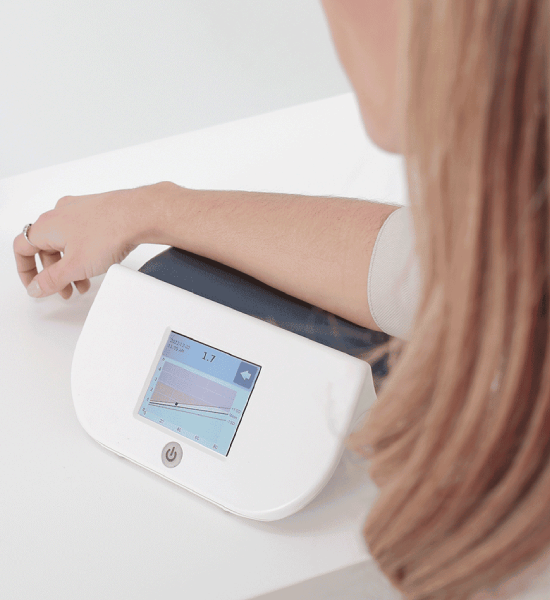
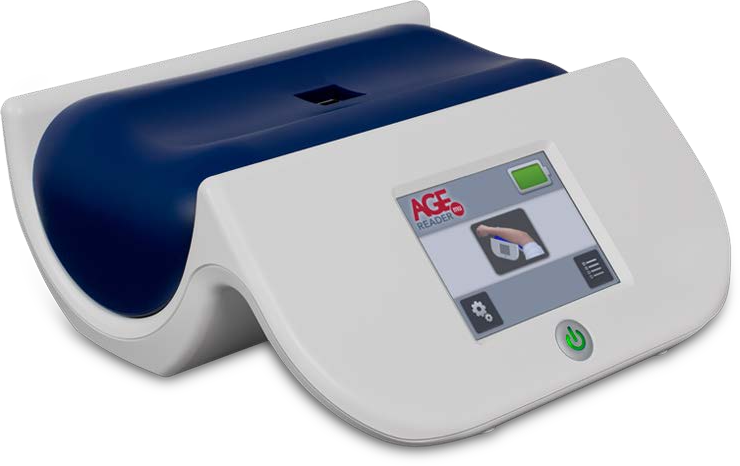
The first clinically validated device to non-invasively measure AGEs via Skin Autofluorescence (SAF), introducing a new paradigm beyond glucose and HbA1c, capturing long-term metabolic stress and tissue damage.
For healthcare professionals
Discover the value of AGE measurement
across specialties
Cardiology
Cardiology
AGE measurement in practice
Clinical case studies and applications
The hidden impact of AGEs
AGEs play a pivotal role in the development
of chronic diseases and frailty
AGEs accumulate silently and disrupt tissues and organs over time. Their effects span from vascular damage to frailty, making them powerful drivers of chronic disease.
Accumulation of AGEs does not happen at the same speed in every person.
Structural damage and loss of tissue function
Microvascular and macrovascular complications
Oxidative stress and inflammation
Acceleration of aging and frailty
Facts & figures
What professionals say
Experiences from therapists and
practice owners
Dr. Elise van Dongen
Endocrinologist
Wider clinical perspective
“What I’ve learned from using the AGE Reader is that AGE values often hint there is more going on beneath the surface. On several occasions, a surprisingly high score prompted me to look further, even when routine markers suggested everything was stable. Follow-up diagnostics tests I normally wouldn’t have ordered based solely on our standard protocol, ended up revealing early complications or hidden metabolic strain.
For me, the AGE Reader doesn’t replace anything; it simply widens my clinical field of view.”
Dr. Lara Meinhardt
Nephrologist
Long-term stress made visible
“I use the AGE Reader because it helps me assess the cumulative stress on my patients’ tissues, which is something single-point lab values struggle to reflect. It has become a tool that sparks deeper discussions about long-term renal and metabolic health.
I appreciate that the measurement isn’t influenced by day-to-day fluctuations—it’s a steady signal. That stability has helped me understand patient trajectories more clearly and tailor my counseling accordingly.”
Dr. James Holloway
General practitioner
Making prevention practical
“In primary care, subtle early warnings are easy to miss. The AGE Reader offers a quick way to see whether a patient may be experiencing more chronic metabolic stress than their routine metrics reveal.
For many of my patients who sit in that grey area, not clearly high-risk but not entirely low-risk either, the AGE score becomes a meaningful prompt for deeper lifestyle discussions. It keeps prevention practical and tangible.”
Dr. Mei Chen
Cardiologist
An extra layer of insight
“What I value about the AGE Reader is its ability to highlight vascular stress that sometimes runs counter to traditional risk profiles. Every now and then, a patient with reasonably controlled lipids and blood pressure shows an unexpectedly elevated AGE level, and that discrepancy has led me to monitor them more closely.
It’s not a determinative test, but it contributes a perspective I wouldn’t have had otherwise. In cardiology, an additional layer of insight is rarely a bad thing.”
Dr. Victor Sharma
Cardiac Surgeon
A stronger view on risk
“My team and I routinely use the EuroSCORE system, and it remains a solid foundation for perioperative risk assessment. But over the years we’ve seen that it doesn’t always capture the full picture of a patient’s frailty or long-term metabolic burden. That’s why we added the AGE Reader to our preoperative workflow.
When AGE levels are elevated, it often aligns with the subtle clinical signs that make us reconsider how aggressive we can be, or whether we need additional optimization before surgery. It gives us an extra dimension, one that reflects cumulative damage rather than just current clinical status.
My hope is that, one day, models like EuroSCORE will incorporate AGE measurements. It would strengthen an already good tool and help us stratify risk with greater precision.”
Partners in science & care
We are proud to collaborate with these partners
We collaborate with leading clinical and research partners to validate applications and
explore new frontiers. From clinical trials to longevity studies, our goal is to strengthen evidence and broaden clinical use.
Want to stay informed?
Subscribe to our
newsletter
Stay up to date with the latest clinical evidence, case studies and insights on AGE measurement.